These yoga routines are designed to be simple, effective and easy to use. You may need some equipment, but most can be substituted with things you have at home. Beginners can try any of the first seven sequences. The Level 1 and Level 2 sequences are for more experienced students.
Staying in the poses is part of the process, to observe the way the body adjusts, learn how to release pain and tension, and allow the body and mind to relax. So it’s helpful to have a timer for these sequences. If you use your phone put it in flight mode.
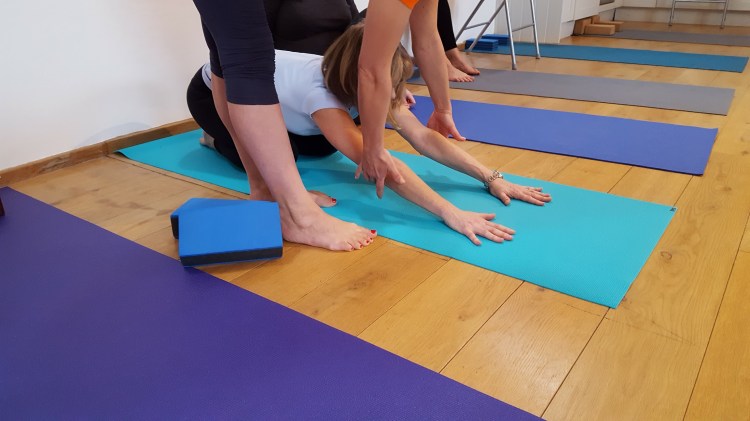
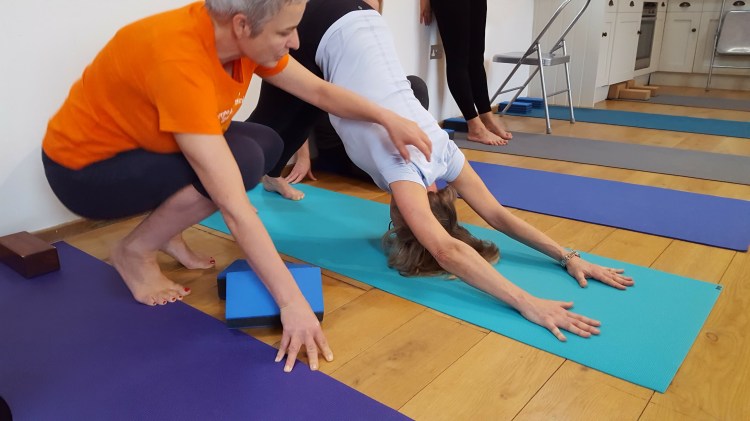
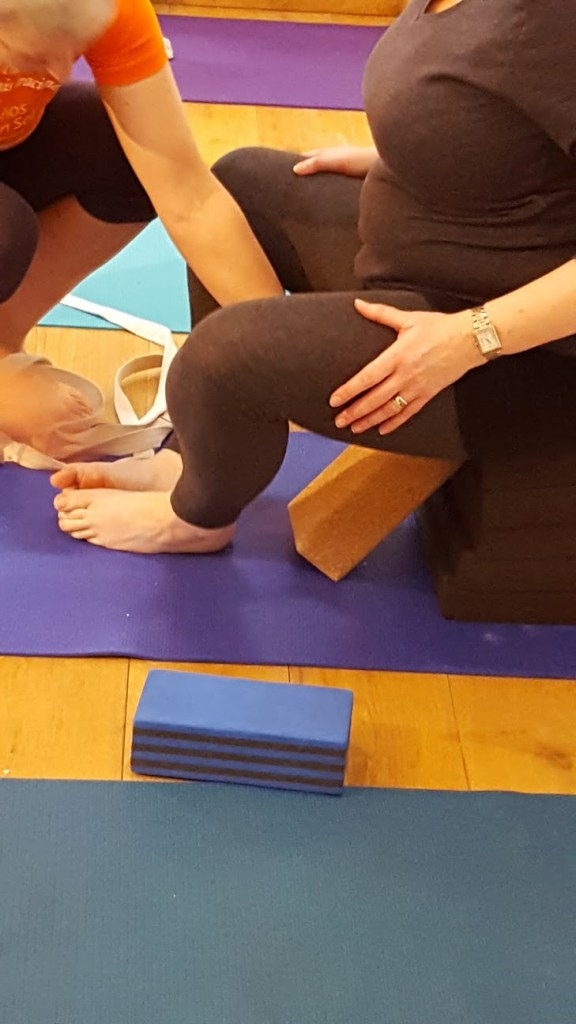
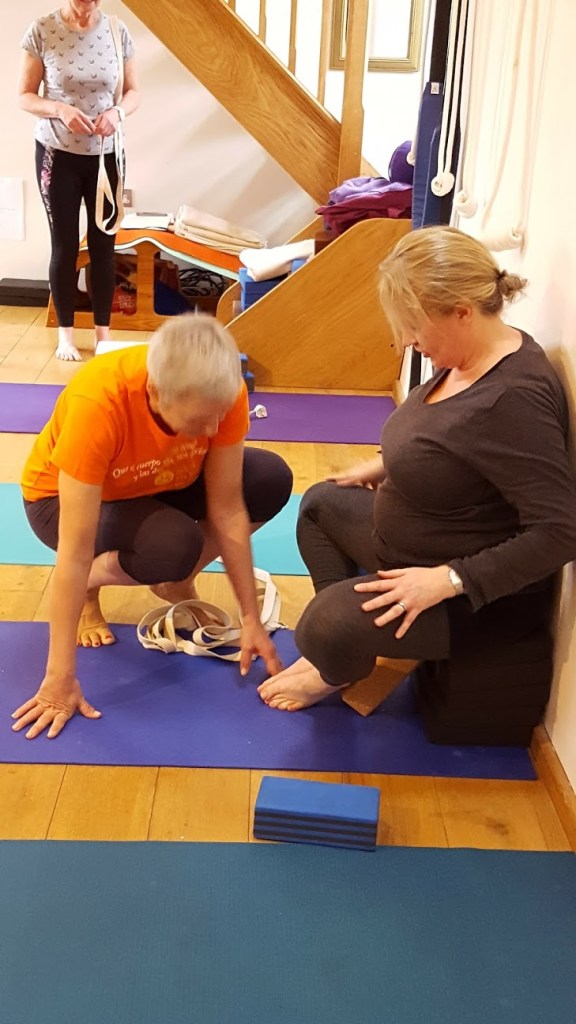
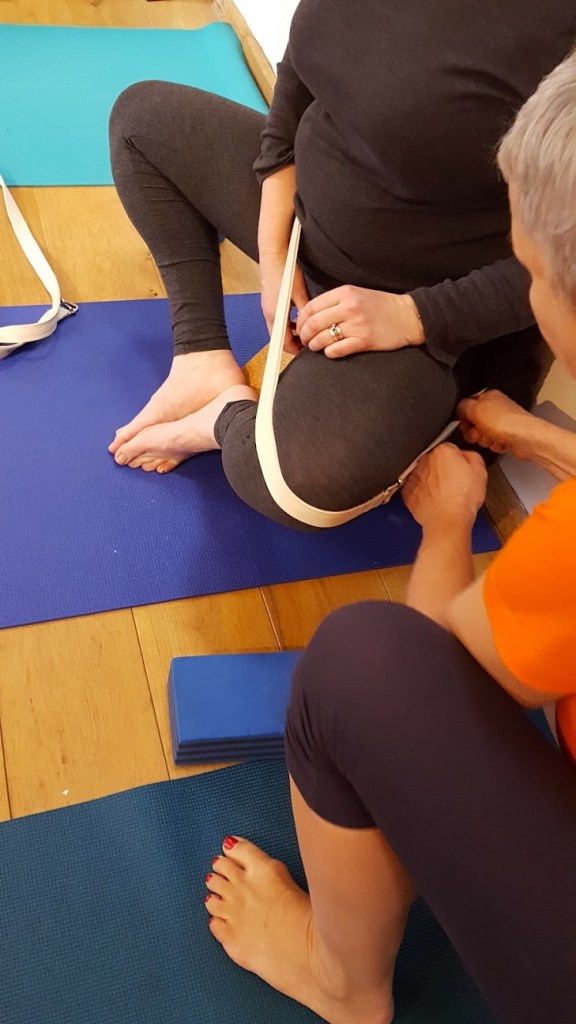
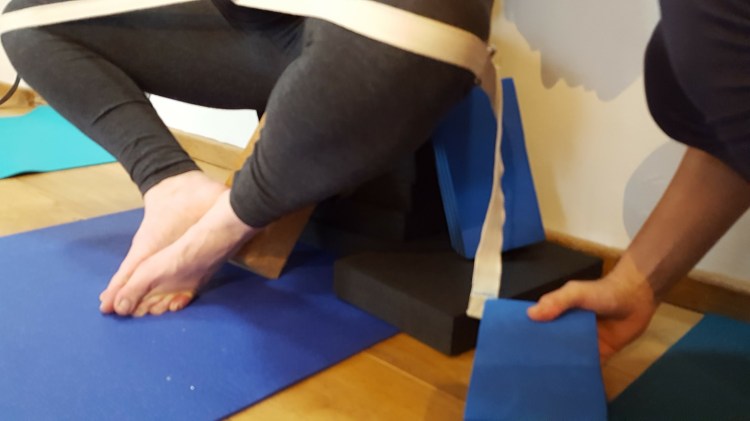
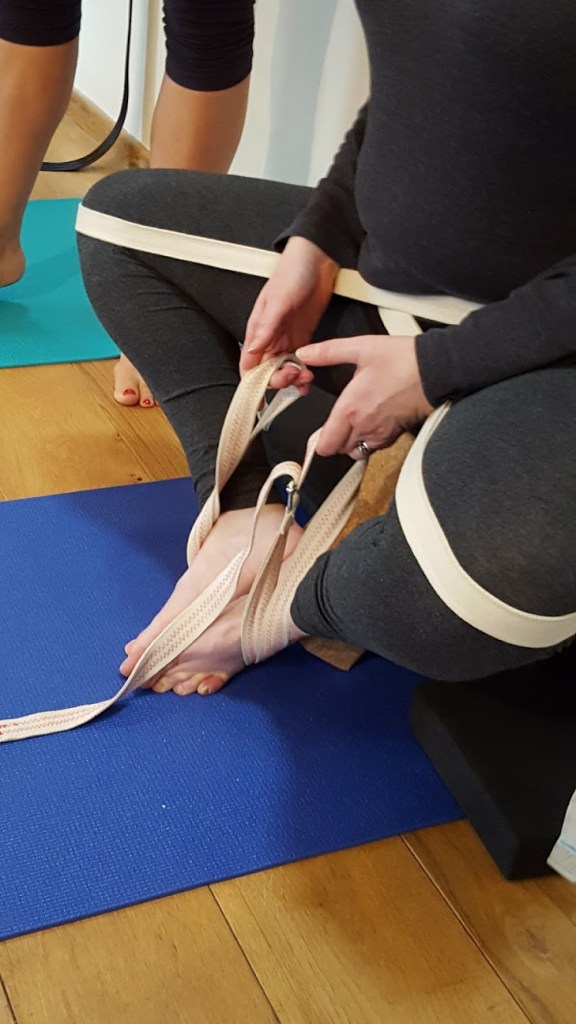
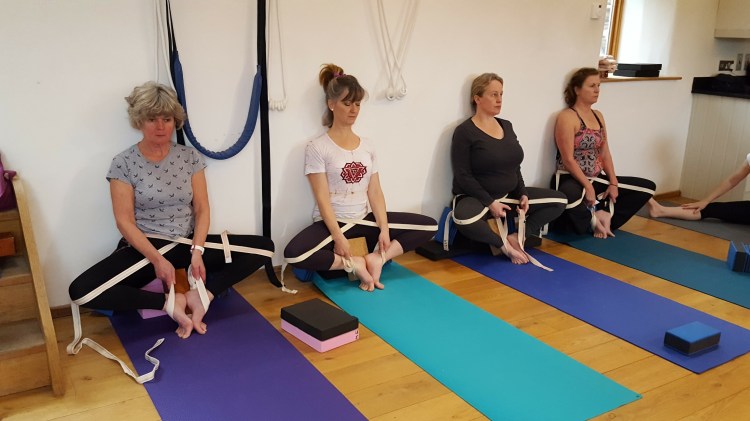
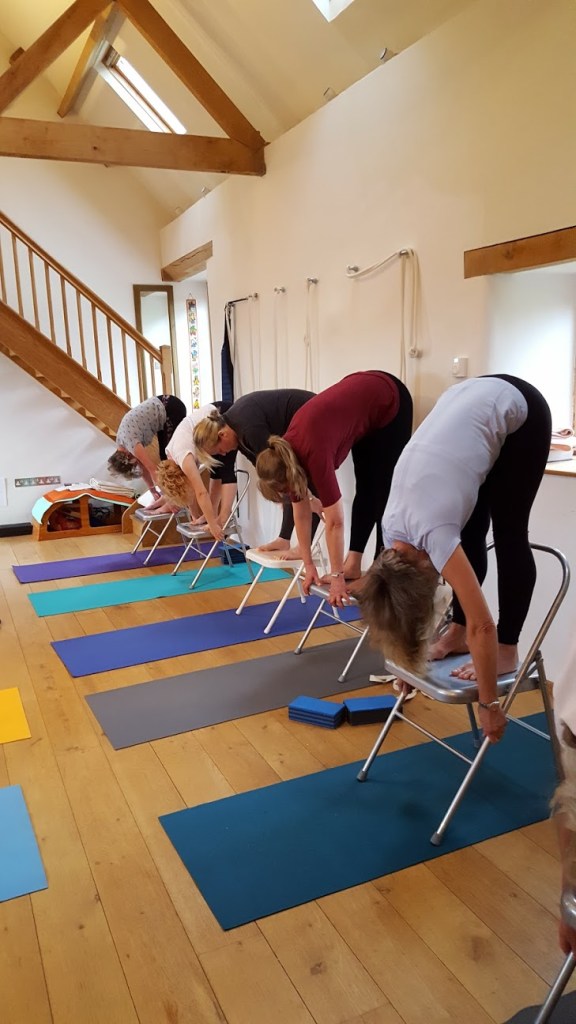
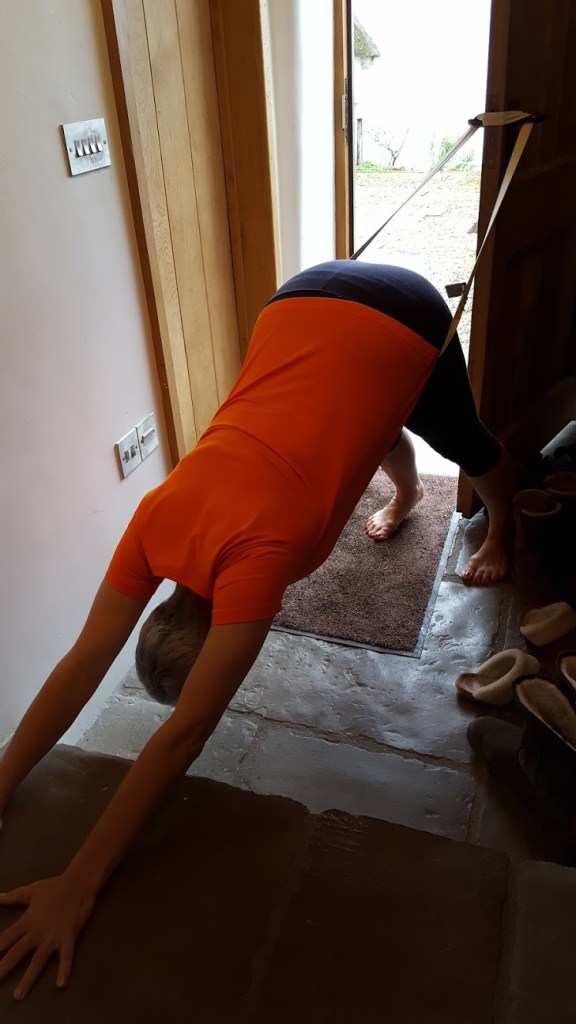
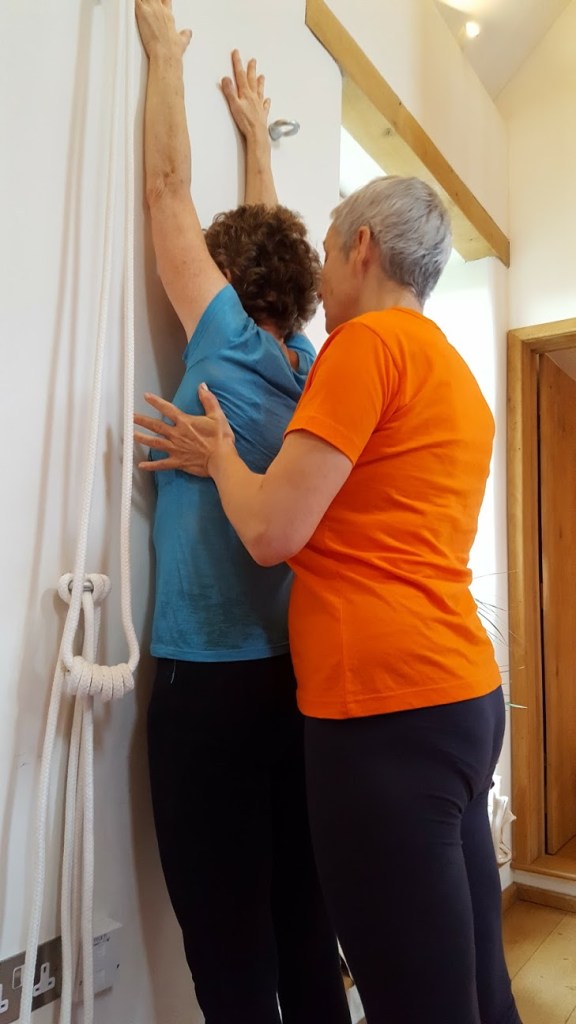
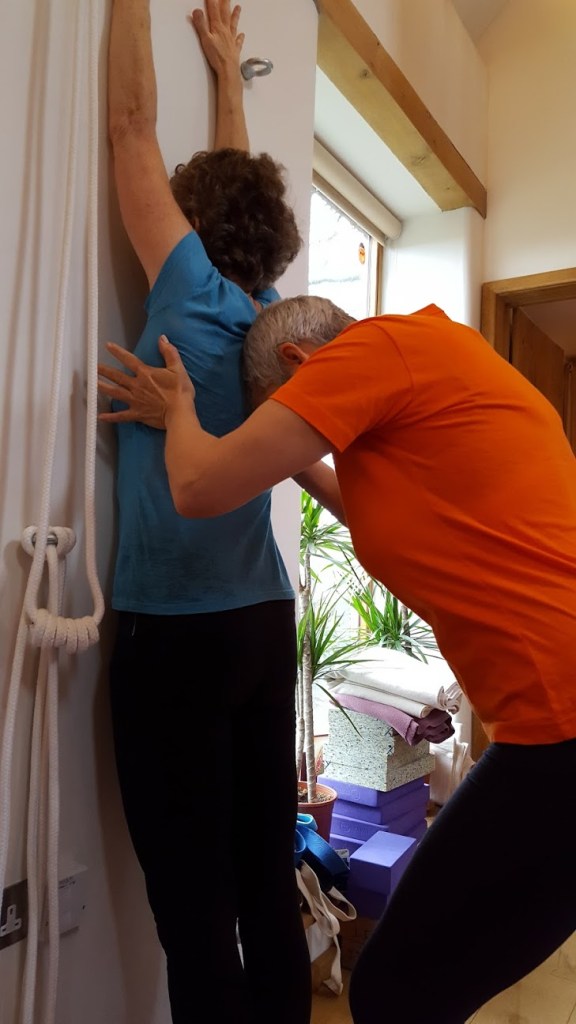
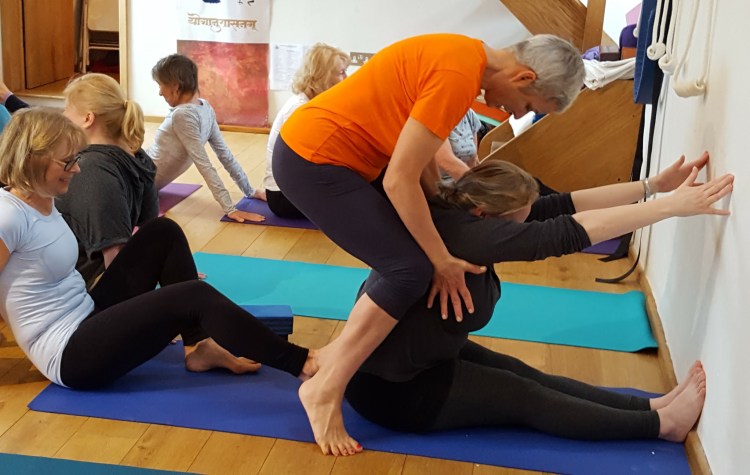
Lifting the elbows/arms up.Keeping them up and moving the thoracic in.Baddakonasana: 5 blocks, a brick.Heels up on the brick, toes splayed.Belt to each knee round the opposite thigh, tighten evenly.Wedge another brick under each femur head, on a block if necessary.Hold a looped belt under the outer edges of the feet.Sit for 10 minutes. To feel the effect in the pelvis and hips, walk slowly round the room when you come out.Chair uttanasana.Using a strap on the door handles to create a sling at home.Side ribs up….…and thoracic in.Side ribs up to encourage forward extension.Sacrum in and up…..…thoracic in.Look from the backs of the eyes.
Returning for another visit, Senior Iyengar teacher and author Bobby Clennell will be teaching at Saddle Street Farm on Weds 26th April 2017.
Bobby Clennell is a long-time student of the late B.K.S. Iyengar, his daughter Geeta S. Iyengar and son Prashant Iyengar. Bobby teaches internationally and visits Dorset every year, taking a break from her workshops and events around the world. We are delighted to welcome her to Saddle Street Farm again this year.
This will be a very popular event so please book and pay your deposit ASAP. (T&Cs including payment details are here.)
10 am – 1 pm: Morning Workshop, includes lunch £45.
2 pm – 5 pm: Afternoon Workshop £40.
10 am – 5 pm: All day including lunch £80.
These yoga routines are designed to be simple, effective and easy to use. You may need some equipment, but most can be substituted with things you have at home. Beginners can try any of the first seven sequences. The Level 1 and Level 2 sequences are for more experienced students.
Staying in the poses is part of the process, to observe the way the body adjusts, learn how to release pain and tension, and allow the body and mind to relax. So it’s helpful to have a timer for these sequences. If you use your phone put it in flight mode.
SUPPORT THROUGH CHALLENGING TIMES: When the going gets tough, and you need to keep going, so take some time to support yourself and you will have more than enough to support those around you.
SUPPORT FOR A DEPLETED IMMUNE SYSTEM: If you have been ill, or are recovering this sequence will support your body’s natural inclination to get better.
YOGA FOR SOUND SLEEP: An evening practice routine, followed by a bath or shower. Leave all technology downstairs, always. Sweet dreams!
The philosophy behind Yoga is vast. It’s practically impossible for a Western person to embrace the beauty and subtlety of it all in just a single lifetime. If you practice yoga regularly, you may have had glimpses of your own inner potential, your natural spirituality. In order to explore that potential further, it’s useful to have a framework, or a map to guide you.
People usually start coming to yoga classes for reasons of fitness, health, flexibility but they find there’s another benefit, one that can’t be described, only experienced. When they come out of a class, everything is the same but something is different. The discomfort and stress in our brains is diminished, mental noise and emotional instability have been replaced by a quiet stability. What is it about yoga, specifically, that does that? And how does that lead to spiritual transformation?
Most of life is an accident that happens to us. We all have commitments, family issues and financial constraints, health problems. Things happen to us, some good, some bad, and we live with the imprint of these accidents for the rest of our lives. For richer or poorer, no one is immune. At times life is extremely uncomfortable, painful and stressful.
BKS Iyengar famously said that, “Yoga teaches us to cure what need not be endured and endure what cannot be cured.” In this quote, he’s talking not just about the body, but the mind and the emotions too.
He also said that health is a state of complete harmony of the body, mind and spirit. “When one is free from physical disabilities and mental distractions, the gates of the soul open.” How can both those statements be true?
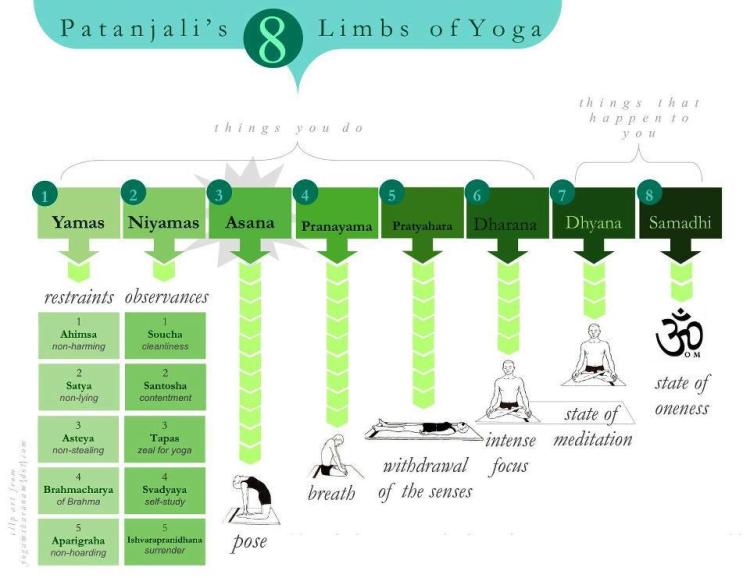
First we must cure what we can and the framework for this is found in the first two of the eight limbs of yoga: the Yamas and Niyamas. The first sets out a series of restraints in order that we might do the minimum amount of damage to others and to ourselves. Then we are encouraged observe and discipline ourselves. The reasoning behind this is very sensible – social justice is better for everybody and natural law encourages us to create a climate around ourselves that is comfortable for us and for others. And self discipline is the key.
Having put our house in order, the third limb suggests we focus on what we can do to counteract the natural physical, mental and emotional stresses of life through Asana practice. Asana means “seat”. When we practice we are developing our inner climate, one which is comfortable and supportive for the spirit. Sometimes the practice is for the body, sometimes for the brain, or the emotions, or the mind. We practice so that somewhere within any one of the asanas, we can find a moment of equilibrium. The asana needs to be physically comfortable, and with skilful teaching (as you find in RIMYI), if we ‘cannot do’ we find a method or a prop to provide that stability so that we can ‘go inside’.
With these first three basic steps, we can cure what need not be endured. The reason we continue to practice is that life goes on, some problems come and go, but some stay and must be endured. We do everything we can to create a harmonious, balanced, protected and receptive climate within and around the physical body from which we can access the spiritual body. It’s not dependent on how many postures you can do or how ‘well’ you can do them. But can you use them to create the freedom from physical and mental distractions and go further, spiritually? How do you do that?
The bridge between this external work and our spiritual world is Pranayama, the fourth limb, simply described as conscious breathing. The link between the body, the mind and the spirit is our Consciousness. Through the asana practice, we learn to read the body and the brain, like a textbook. We stay in the pose and use our intelligence and our breathing to explore further and further. And this is where the Western depiction of yoga loses its way. We improve and evolve, not by ability but by education, by becoming cultured in our practice. Like seasoned wood, which does not change with external conditions, we need to season our consciousness so it is not disturbed by external fluctuations.
And the next step towards this is withdrawal of the senses, Pratyahara, the fifth limb, when the asana practice has settled the body, the brain and the mind, and our consciousness is free to explore our inner landscape. Look at the chart above – you’ll notice the figure is lying down for this stage and then sitting up for the 6th and 7th stages of focus and meditation. We’re entering the realms of prana, energy, nadis and chakras, concepts that are relatively inaccessible to the Western mind, because they exist in many dimensions, and we don’t have a deep familiarity with philosophy.
So first we have to learn to walk. “Illuminated emancipation, freedom, unalloyed and untainted bliss await you, but you have to choose to embark on the Inward Journey to discover it … Penetration of our mind is our goal, but in the beginning to set things in motion, there is no substitute for sweat.” BKS Iyengar.
BKS Iyengar said, “Yoga, an ancient but perfect science, deals with the evolution of humanity. This evolution includes all aspects of one’s being, from bodily health to self-realization.”
The purpose of yoga is to develop our self-awareness and lead us towards spiritual transformation, using the body as a microcosm, a map if you like, of previous incarnations, each of which have left their imprint: karma. Our yogic purpose is to access as many of these imprints as possible, using the asanas to break our resistance, face our fears, and transform ourselves. The body is simply a vehicle. It’s the mind that is the target and it’s very tricky, because it’s always moving, or getting stuck.
‘Dis-ease’ in the human system manifests as changes in our emotional state, a negative mental attitude, physiological changes, altered breathing patterns or a combination of these. One fundamental Ayurvedic understanding is that an imbalance in any of these dimensions leads to dis-ease in others. What manifests in one dimension may have a root cause in another. Yoga practice is recommended in Ayurvedic medicine as a preventive and as a treatment, from a psycho-spiritual perspective. Thus yoga treats all the dimensions of the human system.
But how does this lead to human evolution, self-realisation, and spiritual transformation?
To begin to answer that massive question, we might consider what Jean Gebser called the Four Structures of Consciousness, which he suggests have evolved in our brains since Australopithecus roamed eastern Africa about 4 million years ago. Gebser’s major thesis was that just like any natural organism, human consciousness is and always has been, in transition, something that BKS Iyengar obviously understood.
In the first transformation, the brain of Australopithecus evolved what Gebser called an Archaic Structure of Consciousness, almost completely instinctual with minimal self-awareness. We feel it when we are ‘at one with Nature’. The human being was totally immersed in the world unable to extricate him/herself from that world: they identified completely with that world and had no ego. (Think of a plant or a tree.) Today this manifests in our behaviour as the impulse towards self-transcendence, the need to remove the distinction between subject and object through ecstatic experiences or drug-induced states. Young people often seek this experience during their teenage years.
The second ‘cognitive style’, which Gebser called the Magical Structure, evolved through the era of Homo Erectus, about 1.9 million years ago until as recently as 70,000 years ago. It still pre-dates what we know as the Ego, and it operates at the archetypal level, what we call gut instinct. Today it’s active when we fall in love, when we’re spellbound, or in sympathy with someone or something. In the negative sense, it manifests as temporarily losing one’s judgment, or even one’s humanity, under the hypnotic influence of a large crowd. (Sounds familiar?) Gebser suggests it’s also the cognitive basis for magic, some inward yogic paths, and the cultivation of paranormal powers.
The third transformation of the brain Gebser called Mythical. By this point, Neanderthal and Cro-Magnon people had evolved a degree of self-awareness and ego, similar to that of a child. The Mythical consciousness is active today when we “immerse ourselves in the imagery of the mind*”, when we express to our thoughts and feelings through poetry and art. Symbols & myths, feeling & intuition – these were the contributing factors used by our brains in the creation of sacred texts and ancient writings. We often use symbols and imagery for comfort and support, in times of stress.
These first three transformations involve structural changes in both mind and body and as we evolve, each ‘mutation’ continues to operate to some degree within us.
In the past 1-2,000 years we have evolved a fourth: the Mental. This operates in the domain of the rational mind which has now become acutely self-conscious, with a well-developed Ego. This cognitive style is based on the principle of duality – subject/object, black/white, yours/mine, either/or. And it’s proving extremely unhelpful to mankind and to the planet. Duality gives us only two choices and our fear of making the wrong choice or being told we’re ‘running away from the problem’ is exploited all the time by individuals and organisations whose sole purpose is the getting of power and money.
Julian Lennon
Fortunately, evidence suggests there are millions of individuals who question and reject this approach. In his book ‘The Ever Present Origin”, Gebser suggests we could be witnessing the emergence of a fifth structure – Integral Consciousness. It might be wishful thinking but if he’s right, it could be the antidote to the excessive egoism of Mental Consciousness, along with its denial of our Spiritual reality and our Natural origins.
Integral Consciousness transcends the ego and restores the balance between the various structures of consciousness. It can be difficult to imagine but John Lennon wrote a song that describes what that might look like.
Yoga and other spiritual traditions contain within them many values and elements that could help us. The central principle is the ability to focus and discipline the mind in order for transformation to begin and continue. So when you unroll your mat, you’re becoming part of the solution. Discipline and humility are the key.
*With thanks to Georg Feuerestein PhD and his excellent book The Yoga Tradition.
**For a classic guide to integrating yoga into your daily life: The Tree of Yoga by BKS Iyengar.



 First we must cure what we can and the framework for this is found in the first two of the eight limbs of yoga: the Yamas and Niyamas. The first sets out a series of restraints in order that we might do the minimum amount of damage to others and to ourselves. Then we are encouraged observe and discipline ourselves. The reasoning behind this is very sensible – social justice is better for everybody and natural law encourages us to create a climate around ourselves that is comfortable for us and for others. And self discipline is the key.
 With these first three basic steps, we can cure what need not be endured. The reason we continue to practice is that life goes on, some problems come and go, but some stay and must be endured. We do everything we can to create a harmonious, balanced, protected and receptive climate within and around the physical body from which we can access the spiritual body. It’s not dependent on how many postures you can do or how ‘well’ you can do them. But can you use them to create the freedom from physical and mental distractions and go further, spiritually? How do you do that?
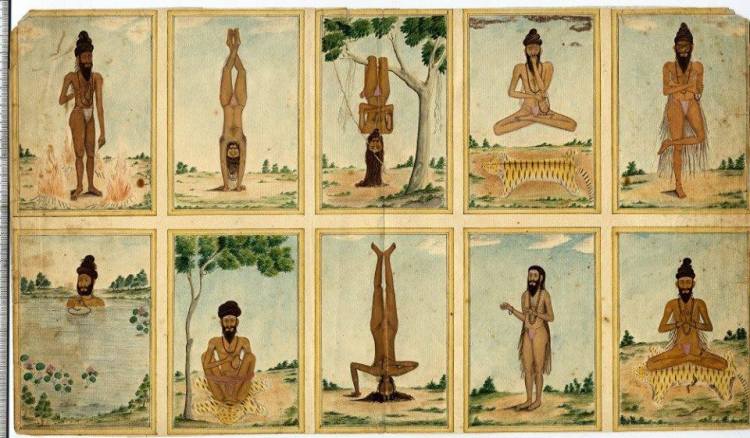 The purpose of yoga is to develop our self-awareness and lead us towards spiritual transformation, using the body as a microcosm, a map if you like, of previous incarnations, each of which have left their imprint: karma. Our yogic purpose is to access as many of these imprints as possible, using the asanas to break our resistance, face our fears, and transform ourselves. T
 In the first transformation, the brain of Australopithecus evolved what Gebser called an Archaic Structure of Consciousness, almost completely instinctual with minimal self-awareness. We feel it when we are ‘at one with Nature’. The human being was totally immersed in the world unable to extricate him/herself from that world: they identified completely with that world and had no ego. (Think of a plant or a tree.) Today this manifests in our behaviour as the impulse towards self-transcendence, the need to remove the distinction between subject and object through ecstatic experiences or drug-induced states. Young people often seek this experience during their teenage years.
 The third transformation of the brain Gebser called Mythical. By this point, Neanderthal and Cro-Magnon people had evolved a degree of self-awareness and ego, similar to that of a child.