
5 simple steps to #yoga practice at home.
Yoga, Pranayama and Meditation – why is home practice so difficult? With a little more time and effort between classes you could develop your practice and begin to understand and enjoy some of the more intangible benefits that yoga has to offer. These five simple steps will help to capture the enthusiasm from class and bring it home into your private practice. It’s really very simple and the only question is what path you might take between steps four and five.
- Place
- Plan
- Time
- Sit
- Lie
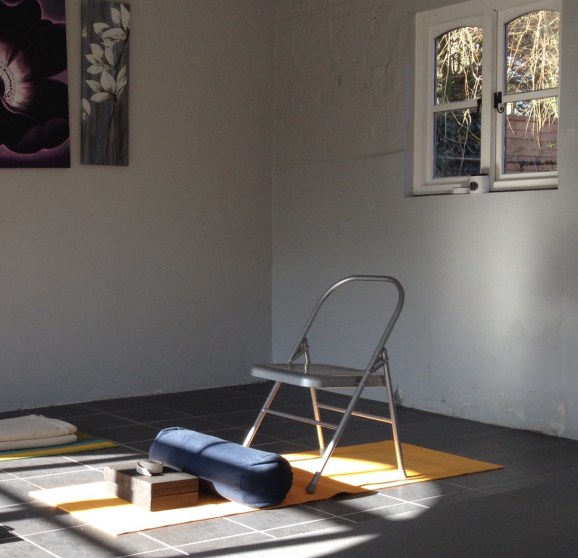 1. Make space – a corner will do, somewhere you can put your mat down and shut the door. In this space, create a sense of the sacred. Use a windowsill, shelf or side table and make a shrine – a tea light, a statue, a flower in a vase – any objects which bring focus to the mind and humility to our intentions. This space reminds and encourages us to do better, to go deeper, and the people around you will appreciate and respect it too. (Saucha – Cleanliness.)
2. Have a plan. Even if your plan is to go with the flow you’ll find it helpful to have structure to act as a reminder once you’re ‘in the zone’. If you want a sequence, write it down. Preparation is an important part of the process. (Santosha – Contentment.)
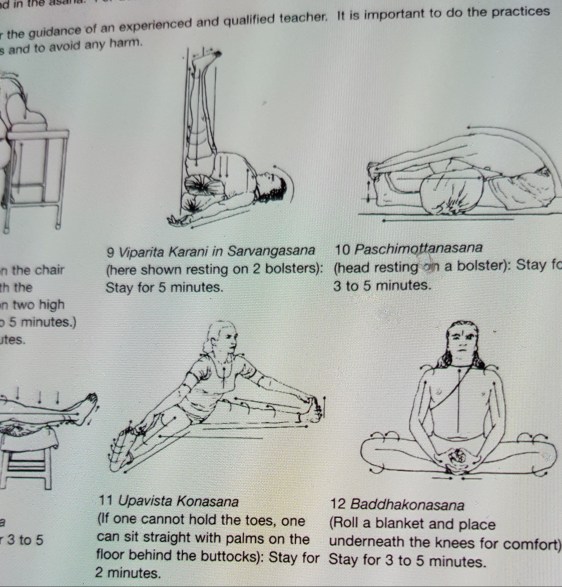
3. Use a timer. To build up your strength and stamina by holding poses, staying in inversions, and for recuperative poses, in home practice the timer is our teacher and our best friend. For Savasana, Pranayama and meditation, a timer can help you to release more and in the end, you won’t need it. If you use a phone or tablet, use it to store your practice notes, make use of the timer, but always put it in flight mode. (Tapas – Discipline.)
4. Always begin by sitting for a few moments. This quiet time prepares the brain and the body: it instills the essence of yoga practice from the outset and reconnects the brain with the body. (Svadhaya – Self Study.)
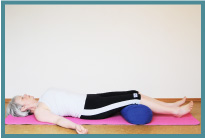 5. Always finish with Savasana. The healing benefits of your practice need to percolate through all the cells of the body and this takes time. Offer up the fruits of your labour (however bitter!) to a higher self. Lie flat, a blanket for the head and/or a chair for the legs, if necessary. Set your timer and if you fall asleep, so be it. (Isvara Pranidhana – Surrender to a higher being.)
Praise in a #Yoga class: is it Satya?
 Satya is the Sanskrit word for truth. It also refers to a virtue, to being truthful in one’s thought, speech and action. In Yoga, satya is one of the five yamas. It is the virtuous restraint from falsehood and, crucially, the distortion of reality in one’s expressions and actions.
A student recently asked me why I didn’t give positive feedback to individuals in class. It’s a question that comes up from time to time. Speaking as a school teacher, she said she spent her working life encouraging and praising pupils for effort and achievement. Why is there no praise in a Yoga class?
There is a stock answer: when I say to a yoga student, “Well done”, I am giving myself a pat on the back. I am saying, “Look! My teaching is so excellent, and this student is living proof!” Is that Satya?
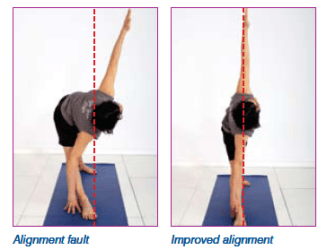 What about all the lessons that student has not learned, the basic actions avoided and evaded even after months and years of practice? Shoulders back, lift your chest – do I still need to say this every time? Clearly yes – I have not taught them this lesson yet. That these actions are not coming tells me their mind is elsewhere or their ego is still in the driving seat, and I have not dealt with those issues. That is the reality, the Satya in this situation. To say “Well done” is to distort reality for both of us.
How many of us experience moments of dread when the teacher moves on to our ‘worst’ pose, the one we love to hate? Somehow we struggle through, cling on and breathe a sigh of relief when they move to the next pose. And then when we are practicing, when we see the results begin to come, is there a part of us that looks forward to showing off our new-found skills and achievements in class, anticipating admiring glances from our fellows and praise from the teacher? Is this Satya?
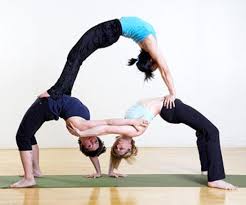 Some students just seem to flow into the most demanding of poses – deep twists, spring up into handstands but how is their practice in, say, Savasana for instance?
And is it so very wrong to quietly say, “Well done” to someone who has been struggling and finally gets up into Urdhva Dhanurasana? When I’m immersed in my teaching, sometimes the words just pop out of my mouth! But what if a student is unlikely ever to achieve that pose? Maybe there’s an injury, a difficulty that precludes them from the final pose – is their effort any the less because of that?
 Saying, “Well done” to someone in a Yoga class is the quickest way to stunt their progress. When someone is praised, in that moment, the learning stops: out come the laurels and the ego, effort ceases and is replaced by laziness, apathy and then disillusion. The brain takes over and their experience of yoga narrows down to a few postures they can use to demonstrate their experience and ability. Satya includes the reality of our inexperience, our inability too.
In Iyengar Yoga the challenge is to learn the essence of the pose, not just its technique or shape. If it was all about form and beauty, Yoga would be an Olympic sport, like gymnastics. When Mrs. Urdhva Dhanurasana finally lifts up from the floor, to say “Well done” creates a distortion of reality: the discipline and effort are gone and the student gets mentally ‘stuck’, believing that’s all they have to do. Their practice will suffer because getting into the pose is only the beginning. My teaching therefore is at fault. That is Satya!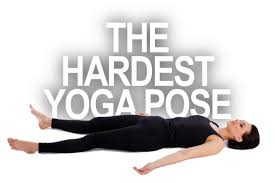
Ten thoughts for ten days.
Take each of these quotes from BKS Iyengar and think about it for a day. Live with it, play with it, daydream with it. I’ve put some of my thoughts beneath each one. Let me know what they mean to you…..
1. ‘Giving does not impoverish. With-holding does not enrich.’
Money is energy – it can only flow smoothly through an open purse.
2. ‘Health is not a commodity to be bargained for. It has to be earned through sweat.’
Taking care of yourself can be demanding.
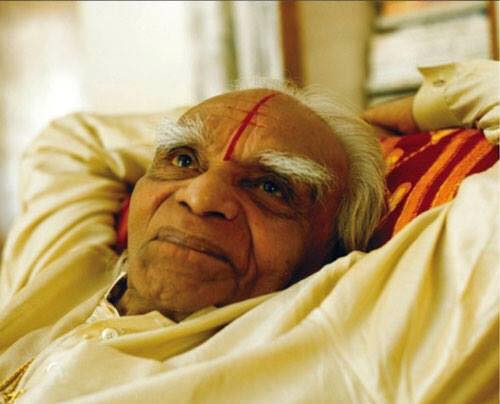 3. ‘Regular practice of yoga can help you face the turmoil of life with steadiness and stability.’
What are the two key words in this quote?
4. ‘Unless people learn to differentiate between the essentials and non-essentials, peace will always elude them’.
Look to Nature for examples of what’s essential. Peace, and the lack of it, is determined by the degree to which we cling to everything else.
5. ‘Self-culture begins only when you are completely engrossed in what you are doing’.
Commit to something, for its own sake, and the doing becomes its own reward.
6. ‘Fear and fatigue block the mind. Confront both squarely, then courage and confidence will flow into you’.
Feel the fear. Do you need to rest first, or do it anyway?
7. ‘Do not stop trying just because perfection eludes you’.
Details matter, and perfection is in the detail.
8. ‘Persistent practice alone is the key to yoga’.
Nothing comes from nothing.
9. ‘The ocean is the self, the waves are the thoughts. The self is silent – the thoughts make noise.’
Make space every day for stillness.
10. ‘If you are happy, pleasant, and unselfish in your behavior towards others, obstacles will shrink. If you are miserly with your emotions and judgmental in your mind, obstacles will grow.’
One of the hardest to master – I find Facebook is a good place to practice this one!
#Leggings or #Pune Pants?
On a day when @united are being dragged over the hot coals of Twitter for enforcing their company’s dress code, #yoga teachers and students the world over are having a major wardrobe crisis. (Just put ‘yoga leggings’ into Twitter and you’ll see what I mean. It’s not tasteful, any of it.)
 As ever, #IyengarYoga has the answer. BKS #Iyengar was a pioneer, in every respect, and many years ago the Iyengar Yoga Institute #RIMYI perfected what we now call Pune Pants. The design allows complete freedom for the body whilst protecting the modesty of the men and women in the class. They are designed like a pair of bloomers but with an extra piece in the gusset so you can bend, extend, squat and twist with no limitation imposed on the movement of the body by the fabric clinging to your skin. If you’ve never worn them, try Eka Pada Sarvangasana in your usual lycra, then try it in cotton Pune Pants…..see? For more choices, see this site HERE: www.frannixon.com
So if you want to see yourself as others see you in class (generally from behind and upside down), push your fist into your leggings. If you can see your knuckles, we can see your knickers. (As a #yogateacher, I’d rather see VPL than a thong any day.)


And if you live in a cooler climate, you won’t have to throw all your cosy leggings away – just wear them underneath. The opportunities for colour co-ordination and fashion statements are endless…..
Photo credit: Ray Burmiston http://www.rayburmiston.com
Ahimsa for yoga teachers.
I’ve noticed several interesting phenomena over the years as a yoga teacher. One of the most surprising and humbling is what I have called the ‘reverse rebuke’ effect. Yoga students display the whole gamut of irritating behaviours in class, triggered by anything from deep-seated habits, or carelessness, to insensitivity and poor discipline. Examples of those behaviours might include a student who despite coming to a regular class for years, seems not to progress and resolutely stays within the boundaries of their ‘comfort zone’; or a student who tries to adjust their body or equipment while in shoulder stand instead of coming down and sorting themselves out; an older student pushing themselves further when the body needs to rest but the ego has taken control; or going into the pose while the teacher is still explaining the points he or she wants to highlight; badly folded blankets and putting props away any-old-how; eating, drinking or checking a mobile phone in class.
 Yoga teachers are supposed to rise above their feelings of irritation – it’s a welcome reminder of Ahimsa, the first of the Yamas – and when our instructions aren’t working, teachers have to find a different way to get the effect we are looking for in the student. That could be a different instruction, or the same instruction in a different pose. Sometimes a change of teacher works. There are students who come back to their regular class after a yoga holiday, waxing lyrical about the teacher who helped them to change the habit of a lifetime, only to realize we’ve been saying that to them week after week but they just haven’t ‘heard’ us. It took a different voice in different circumstances to create that mind-body connection, and then understanding comes for the student.
As teachers, in order to encourage that understanding, we have to determine whether the behaviour is caused by unconscious coping mechanisms, semi-conscious habits or deliberate acts due to poor discipline, a lack of respect or understanding. The unconscious ‘habit-of-a-lifetime’ behaviour may have deep-seated motivation, and lies outside a yoga teacher’s territory. That is to say, we can encourage them to try new things, but we must respect their boundaries. If the student goes too far too fast, the mind can generate much more concrete reasons in the body for it not to venture further, such as aches and pains, even injuries.
New students who come to Iyengar Yoga from different disciplines have to adjust to a much more logical way of teaching, with a greater clarity and precision than perhaps they have been familiar with. Correcting new students can require a sensitive touch in order not to alienate them, but after a few classes they will need to ‘get with the programme’ if they want to penetrate the body with the mind and access the deeper benefits of yoga.
 Which brings me to discipline and the ‘reverse rebuke’ effect. I have written about this before: in yoga, discipline is the key. Students know themselves very well but for obvious reasons they cannot see their own blind spots. It is the teacher’s job to hold the torch. In order that the mind can penetrate everywhere, we have to be willing to look, to see everywhere.
Suppose a student displays a pattern of lazy or careless behaviour. They aren’t responding to an instruction – their mind is elsewhere or they’ve decided they want to do it a different way. I might use a strong, no-nonsense tone to get their attention, and Geeta’s voice and piercing gaze come to mind here. They could take umbrage and never darken my door again, but that can’t be helped. If I let them continue without discipline, I’m taking them down the wrong path: in other words, my teaching is at fault.
In the past, when I felt it necessary to speak sharply to someone in class, I would spend the rest of the class anticipating a negative reaction. I’ve discovered that what happens is usually the opposite: the Reverse Rebuke effect. The admonishment serves to ‘pull their socks up’ for them, to capture their attention and cause them to concentrate. They seem to come alive, to engage, to enjoy the class more. They often come to me and thank me for ‘a good class’. They have their own Damascene moment and convert to the principles of discipline as a means of transformation.

