Weekend Workshop with Bobby Clennell.

Sat & Sun: 25th & 26th April 2020 – an in-depth workshop with international Senior Teacher Bobby Clennell in Lyme Regis. (FULLY BOOKED – waiting list open).

Bobby will be visiting us again this year to give us the benefit of her amazing energy, her profound yoga teaching and wisdom. Her teaching is completely accessible: whatever you think you can do, I can guarantee you will be delighted by her ability to bring out the best in you!

The Masonic Hall in Lyme is in the main street, Broad Street, overlooking the sea. There is a long-stay car park in Pound Road – Holmbush – a ten-minute walk from the hall through Langmoor Gardens and along the sea front. Bring your own lunch or pop out to one of the many cafes and shops. If you want to make a weekend of it, there are good vegetarian/vegan restaurants and B&Bs. See HERE.

Venue: The Masonic Hall, Lyme Regis DT3 3QE (Through the alley next to The Galley cafe.) TBC – please don’t book accommodation until you’ve checked with me!
Cost: £70 per day, with a discount of £15 for 2 days.
Suitable for students with minimum two years’ yoga experience.
Click HERE for booking and payments.
Bring your kit and let me know if you need anything.

Geetaji’s Legacy: A Journey of Breath and Movement

Settling down to planning yoga classes and workshops for the new term, and after attending the BKS Iyengar Centenary event in December, I hardly know where to start. I feel a bit lost! When I left for India in November, I was physically and mentally very low, but I knew that whatever the teaching was, it would be just right for me. (It ALWAYS is.)

When the twelve day event began, I sank gratefully Prashant’s teachings on pranayama over the first five days. There were mutterings of frustration from the young, fit, active, healthy ones, they wanted action – they had been training for weeks no doubt, whereas I was lucky to be there at all! Instead, Prashant was asking us to develop a “culture of tenderness and delicacy”, to battle with our barriers through the breath:

“Don’t get trained. Get educated.”
“Pranayama is not deep breathing. It is breath craftsmanship.”

Exploring the internal purposes of exhalation, he encouraged us to use it like the heads on a Swiss Army knife – to cleanse, wash, expel, offer, evacuate. So for five days we dissected ourselves. It was intense and it felt very good to me.

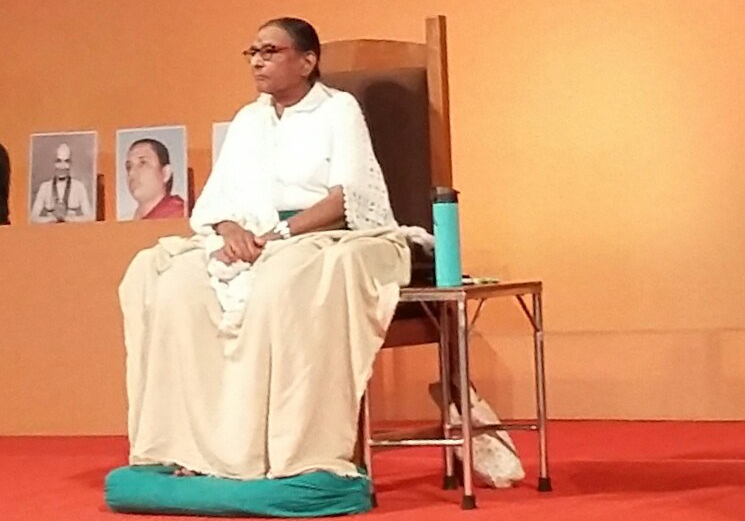
Then, on the sixth day, Geetaji arrived. At 8.30 am sharp for the next five days, she was brought onto the stage in a wheelchair and taught us for four or five hours straight. After lunch it was on to Q&A sessions, back to the institute for meetings, interviews, where she finished at seven or eight in the evening. (On the final day, the centenary of her father’s birth, she was there with her whole family. Rachel and I went to pay our respects – I’m so glad we did.)

She was determined to make us reach inside, plumb our depths, face and deal with our issues. You wanted some action? Well, try this! Again and again she urged us to go beyond our limits, like in Sirsasana:

“Don’t come down. Go back up!

And going further and further over in Halasana:

“MOVE! MOVE!”
“Pain is not the criterion. Movement is the criterion.’
“If there’s a will, there’s a way. If there is no will, there is no way.”

At her feet she had 1,300 people from 56 countries and she knew she had very little time left. She wanted us to go through the pain, the fear, find out what lies beyond:

“There is transformation in every asana.”

Then her work was done, and her time had come. When the event was complete, less than 48 hours later, she died. She had been telling everyone all year that she wanted to see the centenary through, then her work would be done. No-one gave much thought to what she actually meant, though.

And what did I learn? I learned that freedom comes through the exhalation: the gift of yoga is power over life and death.

So back to today and where to start my class planning. Geetaji implored us to read her father’s books, and going back to basics seems as good a place as any. I’ll start with the book co-written by Guruji and Geetaji: ‘Basic Guidelines For Teachers Of Yoga’, and see where it takes me.

In her niece Abhijata’s words: “The cleanest mirror that we had, is gone… Never again will we have someone who was as clear, as simple, as straightforward…Everything else in the world came to a standstill when she was involved in an action…Her life force ended after December 14th…which reminds me of the death of Gandhiji… her work was done, and all she had to do was close her eyes.”

Yoga, a life and a death.

Settling down to planning yoga classes and workshops for the new term, and after attending the BKS Iyengar Centenary event in December, I hardly know where to start. I feel a bit lost! When I left for India in November, I was physically and mentally very low, but I knew that whatever the teaching was, it would be just right for me. (It ALWAYS is.)

When the twelve day event began, I sank gratefully Prashant’s teachings on pranayama over the first five days. There were mutterings of frustration from the young, fit, active, healthy ones, they wanted action – they had been training for weeks no doubt, whereas I was lucky to be there at all! Instead, Prashant was asking us to develop a “culture of tenderness and delicacy”, to battle with our barriers through the breath:

“Don’t get trained. Get educated.”
“Pranayama is not deep breathing. It is breath craftsmanship.”

Exploring the internal purposes of exhalation, he encouraged us to use it like the heads on a Swiss Army knife – to cleanse, wash, expel, offer, evacuate. So for five days we dissected ourselves. It was intense and it felt very good to me.

Then, on the sixth day, Geetaji arrived. At 8.30 am sharp for the next five days, she was brought onto the stage in a wheelchair and taught us for four or five hours straight. After lunch it was on to Q&A sessions, back to the institute for meetings, interviews, where she finished at seven or eight in the evening. (On the final day, the centenary of her father’s birth, she was there with her whole family. Rachel and I went to pay our respects – I’m so glad we did.)

She was determined to make us reach inside, plumb our depths, face and deal with our issues. You wanted some action? Well, try this! Again and again she urged us to go beyond our limits, like in Sirsasana:

“Don’t come down. Go back up!

And going further and further over in Halasana:

“MOVE! MOVE!”
“Pain is not the criterion. Movement is the criterion.’
“If there’s a will, there’s a way. If there is no will, there is no way.”

At her feet she had 1,300 people from 56 countries and she knew she had very little time left. She wanted us to go through the pain, the fear, find out what lies beyond:

“There is transformation in every asana.”

Then her work was done, and her time had come. When the event was complete, less than 48 hours later, she died. She had been telling everyone all year that she wanted to see the centenary through, then her work would be done. No-one gave much thought to what she actually meant, though.

And what did I learn? I learned that freedom comes through the exhalation: the gift of yoga is power over life and death.

So back to today and where to start my class planning. Geetaji implored us to read Gher father’s books, and going back to basics seems as good a place as any. I’ll start with the book co-written by Guruji and Geetaji: ‘Basic Guidelines For Teachers Of Yoga’, and see where it takes me.

In her niece Abhijata’s words: “The cleanest mirror that we had, is gone… Never again will we have someone who was as clear, as simple, as straightforward…Everything else in the world came to a standstill when she was involved in an action…Her life force ended after December 14th…which reminds me of the death of Gandhiji… her work was done, and all she had to do was close her eyes.”
10 important things you need/don’t need in a #YogaClass.

  1. A bottle of water: drinking during class disturbs the digestive system. If you need to hydrate, do so before or after class. And anyway, it’s a trip hazard.
  2. Baggy leggings: your teacher needs to see your legs, ankles and feet. Baggy pants fall down during inversions. And again, they’re a trip hazard.
  3. Food: have you noticed how a good yoga class suppresses your appetite? Have an empty stomach or a little food an hour beforehand, and if you have low blood sugar, fruit is a good standby.
  4. Your own space: don’t cling to the same space every week – change your perspective and help others change theirs. So don’t ask someone else to move – move yourself.
  5. Resistance to change: if you always do what you’ve always done, you’ll always get what you always got. You cannot avoid your own weaknesses or use them as an excuse. Resistance is futile.
  6. Pre-conceived ideas: teachers use different methods to achieve specific effects. The same pose can be energising, relaxing, challenging or healing, depending on the approach. Go inside and see what happens.
  7. Modest clothing: think of it from the perspective of your teacher, or the person behind you. Believe me, a thong/tiny tank top is not a good look and no-one is interested in your tattoo/navel ring.
  8. Humility: our attitude can often be narrow, limiting and rigid. With humility we allow our yoga practice to change and re-shape us, body, mind and spirit.
  9. Humour: good humour is strength of character. Laughing at ourselves, we challenge our difficulties and overcome them. Don’t give up on that handstand: laugh and try again.
  10. The outside world: by definition, things that are common in normal life but are not part of your experience. Leave it all outside the door. Allow your perspective to change and even the most intractable of problems will shift.

On the perils of a search for #yoga leggings.

If you put the phrase ‘yoga leggings’ into a search you’ll see a lot more than you wanted to see. (And a lot of it is not tasteful, especially on Twitter!)

punepant8As ever, when it comes to what the body needs rather than what the ego wants, BKS Iyengar was a pioneer. He designed and perfected all the yoga props we see in use today. Arguably his most universal gift to the yoga community is what we now call Pune Pants. The design allows complete freedom for the body whilst protecting the modesty of the people in the class. They are designed like a pair of bloomers but with an extra piece in the gusset so you can bend, extend, squat and twist with no limitation imposed on the movement of the body by the fabric clinging to your skin, and pulling it in the wrong direction.

Try Eka Pada Sarvangasana (see image from RIMYI, left) in your usual lycra, then try it in cotton Pune Pants…..see? Your groins will love you for it!

For more choices, lovely Indian fabrics , hand-made in the UK, see this site: www.frannixon.com

So if you want to see yourself as others see you, push your fist into your leggings – if you can see your knuckles, we can see your knickers. And you won’t have to throw away all your cosy leggings – just wear them underneath in the winter. The opportunities for colour co-ordination and fashion statements are endless…..

Photo credit: Ray Burmiston http://www.rayburmiston.com

Zubin: Ten Talks About #Yoga (P.S.)

Zubin says: Spend one whole season with these potent thoughts. They have the potential to help you transcend the many ills which have befallen you or will strike you in future time and space.

If I ask you, “Tell me, till what point can your eyes see?” Most probably, and reasonably, your answer would be: until the horizon. But with a powerful instrument, one can stretch that horizon to far-off stars.

A discerning yoga practitioner, with the fine instrument of Yog, can learn the usages of our rich embodiment and look within and beyond the surface horizon, to see the marvellous world of associated body, mind and breath.

Just as an astronomer would peer through a powerful telescope to see and explore our expansive universe, use these ten themes to explore the universe of your own embodiment.

Zubin Zarthoshtimanesh


“For every complex question, there is a simple answer… and it is wrong.” H.L. Mencken

http://www.yogafestival.world

Image: The main practice hall at RIMYI in Pune. (H. Lovegrove)